The Power of Constraints
Today, NBC Sports owns the rights to many of sports’ “crown jewels,” including the Super Bowl, the NBA, the Premier League, Notre Dame Football, and of course, the Olympics. Yet, it hasn’t always been this way.
In the early 1990s, NBC Sports was in trouble. After losing Major League Baseball, the network faced a 32-week hole in its programming schedule, which represented an eternity in sports television. With no obvious answers and little margin for error, NBC turned to Dick Ebersol, the co-creator of Saturday Night Live, to stop the bleeding.
Ebersol implemented widespread layoffs and turned to a young producer named Jon Miller. His marching orders were simple, but stark. Fill the schedule, and do it on a shoestring budget.
What happened next didn’t just save NBC Sports. It quietly reshaped sports television for decades to come.
How?
By turning severe constraints into unexpected opportunities.
Given NBC’s state of peril, the moment was ripe for experimentation. In Miller’s first few months on the job, he threw anything he could on the air. This included events like the NFL Quarterback Skills Challenge, beach volleyball, and the National Heads-Up Poker Championship.
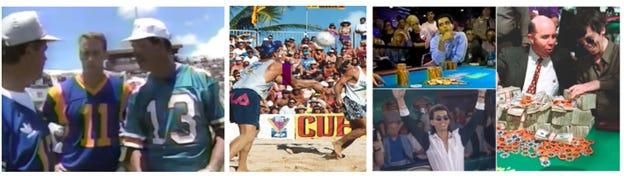 Some worked, others didn’t, but a significant revelation occurred. Being starved of money and resources forced Miller to be relentlessly creative. Most notably, things Miller learned from one experiment led to innovation in others.
Look no further than the inaugural Quarterback Skills Challenge. In passing, Miller asked John Elway and Dan Marino if they would be interested in the prospect of playing in a celebrity golf tournament during the offseason.
The reason?
Miller was looking to fill NBC’s massive hole around the 4th of July, so knowing that NFL quarterbacks were the biggest draw in sports and often pretty good golfers, he thought he there might be something there.
After securing two of the NFL’s biggest stars, along with former standouts Joe Namath, Joe Theismann, and Jim McMahon, Miller launched the American Century Celebrity Golf Tournament at Lake Tahoe, an event that would become a runaway success for more than three decades.
 Witnessing Tahoe’s popularity, Miller saw room for more unique events. Sticking with golf, he turned to an international match play golf tournament that hadn’t generated much in the way of television ratings — the Ryder Cup.
In 1991, Miller secured the rights to the tournament at Kiawah’s Ocean Course and capitalized on a simmering feud between U.S. captain Paul Azinger and European captain Seve Ballesteros. Combined with the surge of patriotic fervor following the Persian Gulf War, the stage was set for an epic showdown that would forever be remembered as the “War by the Shore.” In the process, Miller transformed a once-overlooked event into the most anticipated tournament in golf, every other year.
This success would spawn several more iconic events, including the National Dog Show (a Thanksgiving Day staple since 2002) and the NHL’s Winter Classic, now the highlight of hockey’s regular season.
So, what explains Miller’s actions?
Psychologists have a name for it — cognitive resourcefulness.
In short, when resources are scarce, humans often bypass conventional thinking and take unfamiliar paths to solve problems. In this case, cognitive resourcefulness caused Miller to reimagine what sports television could be. Without dollars to spend, he truly had to think. To solve. To create.
We see this in all walks of life.
Seinfeld, arguably the most successful television show of all time, was primarily filmed on a tiny set meant to resemble an 800 square-foot apartment on the Upper West side of Manhattan. In reality, the set was less than half that size.
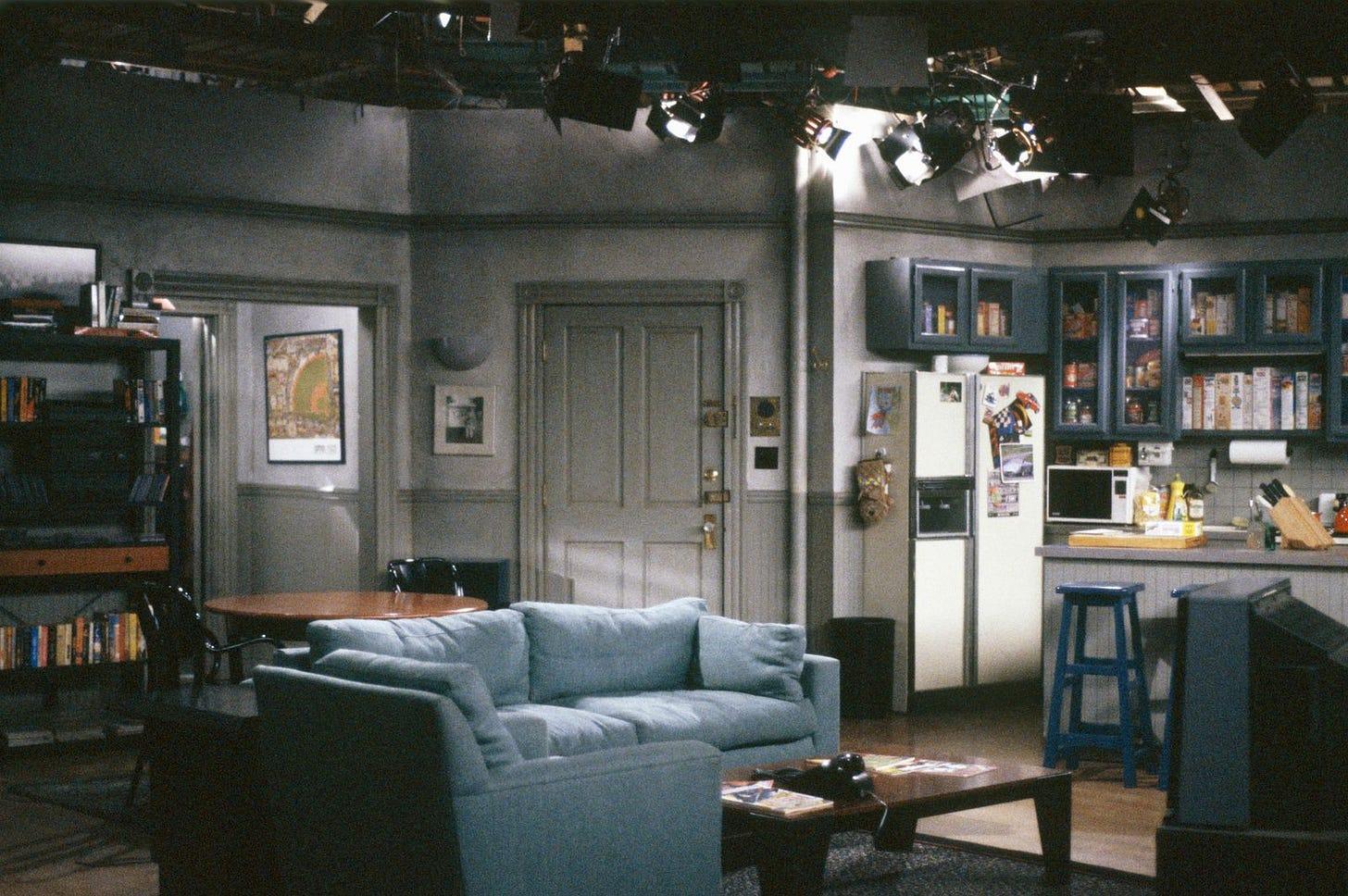 So how did the cast operate within such a tiny space for nine seasons?
As Julia Louis-Dreyfus (aka Elaine) explains, they had to be creative, saying:
“We were always challenged by the size of Jerry’s apartment. It was just so small. What are you supposed to do? You can’t just walk in and sit on the couch every time. This is why I used to do things like go to the refrigerator and just look for things. We were limited, so we had to constantly be creative.”
I witnessed something similar this past summer on our family vacation to the beach. Our boys and their cousins only had a few inflatable toys, two-fold-out chairs, a couple balls, and a rickety goal in the pool. Yet, within minutes, they had invented a game — two points for jumping over a foam noodle and throwing a ball in the goal, five for making it through an inner tube, ten for sinking one into a small basket. First to twenty wins. Limited resources sparked limitless ideas.
Whether it’s an NBC executive, actors in a sitcom, or a group of high-energy kids, if you give someone limited resources and a clear challenge, odds are they will find a way to solve it. Most importantly, they will be infinitely more innovative than if they had unlimited means.
Just look at our economy.
Is it a coincidence that some of our most iconic companies were born during economic downturns?
I doubt it.
As access to capital during the 2008–2011 financial crisis dried up, entrepreneurs were forced to improvise. Airbnb turned spare rooms into a global hospitality network, while Uber built a transportation empire using existing car owners instead of buying a brand-new fleet. Meanwhile, Venmo and Square set out to solve everyday problems with lean, tech-driven models.
How about in the depths of the dot.com bust?
Would you believe me if I told you Palantir and Tesla both were founded in 2003?
The same is true in investing.
Personally, I cringe when I hear that individual investors are “disadvantaged” because they don’t have access to things like private equity and that the only answer is to provide them with access through the “democratization of finance.”
Why?
Because the answer to a lack of resources is not to follow others. Rather, the answer is to be different. To be creative. To think outside the box.
This is why I shake my head when people recommend that average investors should follow Yale University’s David Swensen or Berkshire Hathaway’s Warren Buffett. While Swensen and Buffett had large balance sheets, a supremely talented team, and a network around the world that was second-to-none, you likely have none of these.
However, a lack of resources means you have something they don’t — a license to be creative. It means you have the chance to play your own game, do things differently, and adhere to a game plan unique to you.
So, when should you think about putting a plan in place?
Now is as good a time as ever.
Fifteen years into a bull market with deregulation underway, interest rates being cut, credit widely available, corporate earnings continuing to surpass expectations, and investments in artificial intelligence booming, things feel pretty darn good.
The problem though, as Hyman Minsky was fond of saying, is that,
“Stability breeds instability. The more stable things become, and the longer things are stable, the more unstable they will be when the crisis hits.”
So, what should an investor do?
Go to cash? Run for the hills?
Not exactly.
Rather, it begins with focusing on what you can control. This means positioning yourself and your portfolio to be ready for the next crisis, whenever one hits, so that you can see it as an opportunity rather than a threat.
An opportunity because crises create scarcity and pressing problems that demand solutions.
An opportunity because crises are what spawn companies and innovators who rise to solve them.
An opportunity because you’ll likely be in a position to supply the capital that empowers these folks to succeed (and at much more attractive entry points than we are seeing today…).
For me, this has meant taking a few chips off the table recently and rotating capital from some richly valued parts of the market into lesser trafficked areas (e.g., REITs, biotech, select parts of international markets, etc.).
More importantly though, I have dusted off Dan Rasmussen’s “crisis investing” framework and started thinking about what I will do when a crisis hits. This has meant determining what companies, funds, or parts of the market I will want to invest in and what will trigger those investments (e.g., a specific percentage sell-off, credit spread limits, valuation triggers, etc.). It has also meant making sure I am completely comfortable with what I currently own, so that when things do crack, I will be able to hold them through to the other side.
The fact is, I have no clue when the next crisis will occur. No one does. Yet, it is hard to deny that we are closer to one than we were 1-, 3-, 5-, and certainly 10-years ago. This is especially the case given the S&P 500 has compounded at 20% over the past six years and annually at 14% for fifteen (the NASDAQ has been even more pronounced generating an annual return of 27% for the past six years and 18.5% over the past fifteen).
The reality is that when one of these moments does come, things will feel uncertain, even dangerous. Future prospects will look grim. As a result, most investors will turn bearish, retreat, and de-risk. However, that’s when the instinct should be to do the opposite. That’s when you should turn to the playbook you built when things felt more stable.
The reality is, these are the moments when innovators and visionaries like Jon Miller, Brian Chesky, and Elon Musk don’t just survive — they reinvent the game. And when they do, that’s when you need to invest.